
Showing posts with label Directors. Show all posts
Showing posts with label Directors. Show all posts
Directors: Roger Corman
Sundance Film Festival 2011 Corman bio hits the indie movie theater circuit.
Documentary film CORMAN'S WORLD: EXPLOITS OF A HOLLYWOOD REBEL prolific writer-director producer, and seminal influencing force in modern movie making over the last 60 years.
Featuring interviews with Hollywood icons and cinematic luminaries, some who launched their careers within Corman's unforgettable world of film-making, including Paul W.S. Anderson, Peter Bogdanovich, Robert De Niro, Peter Fonda, Pam Grier, Ron Howard, Eli Roth, Martin Scorsese, William Shatner and Jack Nicholson, along with many others, this documentary chronicles Corman.
References:
IMDB, Trailer Corman's World (2011)
IMDB, Corman's World Movie Info
Directors: Joe Sarno
 So where did sexploitation come from? Where did it go? To answer that question you must examine the career of proto-porno film director turned hardcore porn film director Joe Sarno.
Joe Sarno, born in 1921 in Brooklyn, had a very successful career in sexploitation a genre that he widely contributed to before becoming a mainstream porn director in the 1980's.
His films examined very real questions about hypocrisy and desire among men and women. Sarno's seemingly bizarre takes on romance concern the place of sex in cultural identity by voicing the questions that were being asked by 1960's American counter-culture to their parents - parents who came from a generation that fought World War Two and whose own parents had survived a ravenous Depression.
This generation gap combined with wide spread political corruption, political upheaval, and an unjust war raging in southeast Asia created a need for a dialogue. What better place than the movie theater?
Sarno, a Navy photographer on South Pacific bombing runs during WWII, became a sexploitation director with his first official feature Sin In The Suburbs (1964). His movies catered to the wilder side of square audiences in the "softcore" market. Sarno's early films confronted sexual frigidity and traditionally accepted hypocrisies about love, women and power by shining a high-powered light into an exaggerated version of mainstream American culture - right were it got it on at.
He did so with unusually well crafted films using stark lighting, long takes, and a purposeful focus on character development. This type of rigorous staging achieved a powerful effect with his actors.
| "The big thing with films — a film is the result of a human relationship, and when you write it to begin with, it's got to be about a real human relationship ... that's the whole secret of the thing. Without that, you have nothing." |
| - From an interview with Joe Sarno in RE/Search #10: Incredibly Strange Films. |
After spending many years in a tumultuous American culture as a sexploitation director Sarno moved on to the hardcore porn market simply because popular culture had accepted the place for softcore porn in theaters and collectively yawned.
The Love Merchant directed by Joe Sarno in 1966.
As a contemporary of Roger Corman said: "Tits are the cheapest special effect in the business..." and although tame by today's standards Sarno used sexuality with a brilliance that was often mishandled by many of his peers including Corman and Russ Meyer - and undoubtedly is continually mishandled today.
Selected Filmography:
Sin You Sinners (1964)
My Body Hungers (1964)
Red Roses of Passion (1966)
The Love Merchant (1966)
The Love Rebellion (1967)
The Indelicate Balance (1969)
The Young, Erotic Fanny Hill (1970)
Deep Throat 2 (1974) (Rated R!)
Confessions of a Young American Housewife (1974)
Inside Little Oral Annie (1984)
Coming on America (1989)
Screw the Right Thing (1990)
Before his death, at age 89 in 2010, Joe Sarno's work was the subject of many gallery and film fest retrospectives including the New York Underground Film Festival, the Torino Film Festival in Turin, Italy and the Cinémathèque française in Paris.
References:
IMDB, Joe Sarno
RE/Search #10: Incredibly Strange Films
Mondo Digital, Films of Joe Sarno
Jah Sonic, Joe Sarno
RE/Search #10:Incredibly Strange Films Edited by V. Vale, Andrea Juno, Jim Morton RE/Search Publications San Francisco October 1986
Facebook, Red Roses Of Passion
Directors: John Carpenter

John Carpenter in the process of editing Escape From LA in 1996.
John Carpenter is a one-of-a-kind film director who created classic horror movies including the Halloween franchise and Escape From New York, starred in hardcore horror TV shows like Body Bags and was know for writing his own minimalist and experimental soundtracks for his work from 1970 up to the present day.
Carpenter was born in Carthage, New York in 1948 and moved to Bowling Green, Kentucky as a boy. Carpenter grew up in a log cabin and was educated in a one-room schoolhouse. According to his biography, John Carpenter: The Prince of Darkness by Gilles Boulenger, he also grew up around the elements that eventually fed into his movies.
On one hand, he had his musically talented parents - his father was a virtuoso violinist and music professor, on the other hand in talking about his childhood to Robert Koehler in Variety in 1991, he says he was surrounded by indescribable and brutal violence from an early age.
These conflicting elements would contribute to his desire to play and compose, which he does for nearly all his films, that deal with violence and death.
He began college at Western Kentucky University where his father, Howard Carpenter, taught classical music courses but transferred to USC for Cinematic Arts in 1968. One of his short films, The Resurrection of Bronco Billy (1970), won an Student Academy Award and was nationally distributed before he graduated in 1971. The themes of his later films were shaped by the political turbulence in the late 1960's, especially in California, which figured directly into the movies he directed.

Kurt Douglas and John Carpenter prepare to do battle in Big Trouble In Little China (1986).
For example, strife leading to crucial and uneasy alliances in The Thing (1982), the politics of poverty among the "have-nots" in They Live (1988), and the brutality of prison culture in Escape From New York (1981) were films that were based on issues that defined the 1960's.
College-aged kids protesting the war, white and black activists in SNCC and other on campus groups in the 1960's, such as in the Freedom Riders and Viet Nam Veterans Against The War, had their lives regularly threatened. At demonstrations and boycotts protesters faced anonymous death threats, angry crowds of police and counter-protests in America. When racial tensions exploded, USC students, whether they had political agenda or not were in the center of LA to witness the riots of 1965 in Watts and in 1968 and 1971 in greater LA.
This kind of rage can be seen in the The Thing as the body of man rebels under an "alien" influence to destroy human command structure from above. The story is told through the eyes of the unlikely and lowest ranking heroes, Kurt Russell and Keith David, who end up, presumably, as the sole survivors. The plot follows a isolated, disintegrating outpost where anyone can be the enemy as an alien organism destroys the tiny Antarctic outpost. Lawlessness and a constant threat of horrible death from friends in claustrophobic quarters makes a great horror film. It is reflective of the social chaos in LA and the paranoia of Cold War politics.
As the Antarctic base is destroyed, along with any hope of survival inside of the military station, MacReady and Childs are left to die in the subzero cold as they carefully watch each other for signs that one of them is also "The Thing"0.
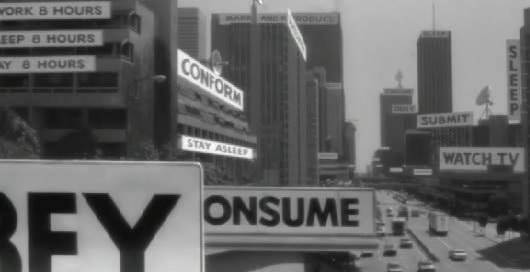
In John Carpenter's futuristic 1988 LA, ads get right to the point.
The themes of societal upheaval and individual paranoia are echoed in They Live (1988). In this film, the fight is taken to the Establishment by "Rowdy" Roddy Piper and Keith David. The Establishment in this is case are corporate aliens who are "buying" Earth by co-opting it's wealthiest citizens. The aliens lay waste to human higher brain function through TV, media and money while sending riot police into LA to destroy misfits - those who won't "play ball".
This time, at the end of then film, there are no survivors. David and Piper are executed by Piper's traitorous love interest. As he is shot in the back, Piper, or Nada as Carpenter dubs his hero for this film, attacks the alien signal used to control and corrupt humans. The signal, broadcast from on top of an LA tv station, is temporarily disrupted. At the end of the picture, the aliens are revealed for what they are - bug-eyed zombies.
In each of these fiercely anti-authoritarian films, the heroes are fighting off a powerful, nebulous and shape-shifting enemy. This enemy's most deadly ability is to co-opt or "take over" a friend from the inside much like in the the Thing.
However, in They Live, the former friends choose to "play ball" with their evil master for financial gain. This was much like informants and FBI agents that monitored the completely legal activities of civil rights leaders, youth groups and activist organizations in the 1960's and 1970's.
In They Live and as in real life, an embedded enemy could be right among the movement - never to reveal itself until it was too late.
In these films, there is an added degree of realism. The heroes don't like each other but work together to survive against a powerful enemy. It's interesting to note that Keith David appeared in both The Thing and They Live as an unwilling accomplice. In each film, his character bitterly fought against the outsider protagonist embodied either as the sombrero slinging MacReady or the angry drifter Nada. After fighting to a near stand-still, David played a pivotal role in destroying the threat to Man's dominion in The Thing and disrupting the sale of Man's soul in They Live.
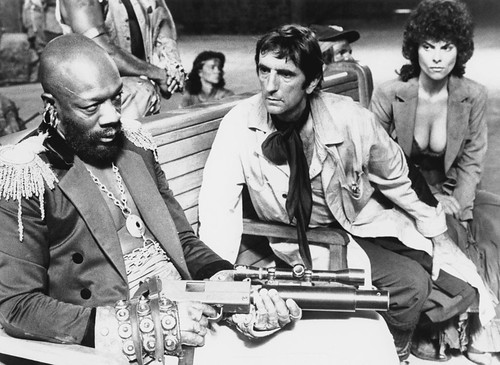
Issac Hayes the A #1 Duke of New York, Harry Dean Stanton as Brain and Adrienne Barbeau as Maggie.
The revolt of prisoners in Attica, New York in 1971, due to brutal conditions and severe overcrowding (ACF was built to hold 1,200 inmates and housed 2,225) comes in the form of the Duke of New York played by Issac Hayes. The Duke takes the President of the United States (a quaking Donald Pleasance) hostage in exchange for escape from the giant prison city.
The Duke uses his army of criminals to first hunt down the President and then kill the nearly unkillable Snake Plissken, a veteran warrior given the impossible task of tracking down and saving Donald Pleasance's neck. At the end, Plissken succeeds and none of the prisoners Plissken bargains with escape New York. Freed, the President returns with an audio tape containing with what he assumes is the formula for a cold war doomsday weapon. Instead, he is in possession of Ernest Borgnine's rockin' big band mix. The formula was the real reason why Plissken really went inside the city prison in the first place. The ending confirms Carpenter's view of the cold blooded nature of bureaucracy by placing the value of a weapon over human life - even when that life is the President of the United States.
This theme is recognizable in American culture and history. Greed, riots, and outsider heroes in situations echoing the social changes taking place in America. Audiences responded to John Carpenter's sci-fi and horror films because they were socially relevant and very entertaining. The characters had a grim credibility because they could have walked the streets of 1960's LA just as easily as they did in post-Apocalyptic New York.
Before his first big success in film, Carpenter worked on a shoestring budget on Halloween (1978) which cost $320,000 to make but made $45 million in the US when released. The unofficial word is: the original Micheal Myers mask for Halloween was actually a rubber William Shatner "Kirk" mask painted white early into production. The Fog (1980) made as a "studio" film for $1 million and earned $21 million in the US when most films cost 10 times as much to make.
When his career gained momentum in Hollywood during the production of The Fog, and two years after Halloween was released, Carpenter married the film's star Adrienne Barbeau who starred in Escape From New York (1981), Swamp Thing (1982), and George Romero's Creepshow (1982)). In the late seventies, Barbeau was one of the hottest actresses and sex symbols in the world. Carpenter was on top of the world both personally and professionally. The two were married from 1979 to 1984 and had a son together in May of 1984.
Today, John Carpenter is still a good friend of Stephen King and George Romero both of whom he has worked with on major films like Christine (1983) as a director and as a producer for Creepshow (1982). Aside from the many terrible Halloween sequels, he enjoys what most director's dream of: recognition for a series of uncompromising films that were both critically and popularly successful.
Selected Filmography:
Assault on Precinct 13 (1976)
Halloween (1978)
Elvis (1979) made for TV
The Fog (1980)
Escape From New York (1981)
The Thing (1982) - score by Ennio Morricone AD'ed by Howard Hawks
Big Trouble In Little China (1986)
They Live (1988)
Into The Mouth of Madness (1995)
Notes:
0 = The prequel to John Carpenter's Thing was filmed in Toronto and will be released in the U.S. on October 14th 2011.
References:
Wikipedia, John Carpenter
Official John Carpenter Site, Variety Interview By Robert Koehler
Marc Bright, John Carpenter Bio
Unofficial John Carpenter, Forum
VVAW, Viet Nam Veterans Against The War
Discover Networks, Modern Propaganda Against VVAW
Video-On-Demand is available at:


Directors: Roger Corman
 Roger Corman, born in 1926 in Detroit, is one of the most prolific film makers in the history of the medium. During his 50 year career, Roger Corman wrote, produced and directed over 400 movies. He worked primarily as an independent outsider due to his intense work ethic and unusual subject matter.
Finding little support in the major studio systems he eventually made and released hundreds of motion pictures for his own production companies (New World Pictures and Concorde) in Southern California. Along the way, he shaped the careers of the biggest directors in Hollywood.
Roger Corman's movies were the text book definition of "exploitation" film. Exploitation came into being as a term to describe B-movies, such as Reefer Madness (1936) or Teenage Dope Slaves (1951), as films that dealt with topical or "ripped from the headlines" subjects. These films had very little in the way of emotional depth in the characters or the plot lines. This created a farcical atmosphere that was pure entertainment often operating under the guise of a "message film".
In the mid-1950's, the genre evolved to become heavily focused on the female form and violent themes. This new frankness in popular films combined with the booming drive-in theatre market made Corman the unoffical "King of the B's" during the 1960's and 1970's in America.
Prior to his career in pictures, a young 14-year-old Corman and family relocated to Beverly Hills in 1940. He graduated from nearby Stanford, a mostly military school, with a B.S. in Electrical Engineering. After a brief stint in the Navy he was hired as a messenger by 20th Century Fox in 1948. Corman became a story analyst the next year for the studio.
After deep frustration in dealing with studio politics Corman would abruptly leave the traditional studio system. Corman cites one incident in particular in which he recieved no credit for his work as a script doctor. Gregory Peck's The Gunslinger (1950) became a hit for 20th Century Fox and the production executive received a huge bonus due to Corman's sheparding of the original script. Corman, however, didn't even recieve a screen credit. Corman would eventually remake the film six years later for the notorious American International Pictures by shooting it in Kanab, Utah.
After this set back, a frustrated young Corman left Hollywood to attend Oxford, in England. While pursuing a Masters degree in Literature he ended up pursuing counter-culture instead - finding it in Paris jazz clubs and Amsterdam coffee bars. After a spending year in London and Paris he dropped out of Oxford and came home to Southern California.
At the time of his return, his brother, Gene Corman, was already a successful Hollywood agent for MCA. But Roger was left without any resources that he needed to make films even though he lived in the heart of the film making capital of the world.
Using his talents as a warm, talkative but frugal deal broker the 28-year-old Roger Corman recruited resources and talent from a pool of former classmates and their families once he secured the use of an expensive prop plane from an aircraft company. He gave the directorial duties for the film to a member of his finance commitee and made a movie that became a staple of late night creature features: The Monster From The Ocean Floor (1954).
This would become the trademark independent/guerilla style that Corman would use on many of his features. Due to his knack for knowing what the public was interested in seeing he rarely lost money on his pictures. Corman would reserve part of the budget of a current picture's production budget as capital for the next picture, hire friends for important parts and re-shoot on old sets. Corman was known for wrapping Production in as little as a week for a 90 minute film!
For decades, Corman also made a habit of hiring young film makers as writers or directors - some right out of film school. These film makers would go on to shape Hollywood with their own projects. The most successfull graduates of the "Roger Corman School of Film" included Martin Scorscese on Boxcar Bertha (1972), Francis Ford Coppola on Dementia 13 (1963), Joe Dante on Piranha (1978) who would later direct Gremlins (1984), Amazon Women on the Moon (1987) and the original Howling (1981), Johnathon Demme on Caged Heat (1974), Peter Bogdonovich on Targets (1968), and James Cameron on Pirahna 2: The Spawning (1981).
Since the 1990's his fantasic collection of films have largely been forgotten by mainstream media but Corman's influence is heavily felt through his series of proteges who went on to be some of the most widely felt creative forces in Hollywood history.
| Selected Filmography: | |
| d = directed / p = produced or exective produced. | |
| Atomic Era | Horror Comedy Era |
| Monster From The Ocean Floor (1954) - p It Conquered The World (1956) - d Attack of the Crab Monsters (1957) She Gods of Shark Reef (1958) Attack of the Giant Leeches (1959) The Wasp Woman (1959) - d X, The Man With X-Ray Eyes (1963) - d Death Race 2000 (1975) - p Eat My Dust! (1976) - p Grand Theft Auto (1977) - p Avalanche (1978) - p Pirahna (1978) - p The Bees (1978) - p Burial of The Rats (1995) - p | Bucket of Blood (1959) - d Little Shop of Horrors (1960) - d Creature From the Haunted Sea (1961) - d House (1986) - p Munchie (1987) - p House II (1988) - p Frankenstein Unbound (1990) - d |
| Blaxploitation Era | |
| The Arena (1973) - p Coffy (1973) - p Foxy Brown (1974) - p TNT Jackson (1974) - p | |
| Poe Cycle | Youth Culture Films |
| House of Usher (1960) - d The Pit and the Pendulum (1961) - d Premature Burial (1962) - d Tales of Terror (1962) - d The Raven (1963) - d The Haunted Palace (1963) - d Masque of the Red Death (1964) - d The Tomb of Ligeia (1964) - d | Swamp Women (1955) - d Carnival Rock (1957) - d Rock All Night (1957) - d Teenage Doll (1957) - p Soroity Girl (1957) - d Teenage Caveman (1958) - d High School Big Shot (1959) Wild Angels (1966) - p The Trip (1967) - d Gas-s-s-s (1970) - d Rock 'n' Roll High School (1979) - p Suburbia (1984) |
| Sexploitation Flicks | Space War Films |
| Women in Cages (1971) - p The Big Doll House (1971) - p Night Call Nurses (1972) - p Caged Heat (1974) Candy Stripe Nurses (1974) Sorority House Massacre (1986) - p Slumber Party Massacre II (1987) - p Stripped to Kill (1987) - p Barbarian Queen II: The Empress Strikes Back (1989) - p The Haunting of Morella (1990) - p Overexposed (1990) - p Immortal Sins (1991) - p | War of The Satellites (1960) Battle Beyond The Stars (1980) - p Galaxy of Terror (1981) - p Android (1982) - p Forbidden World (1982) Space Raiders (1983) - p Droid Gunner (1995) Starquest II (1997) |
With over 300 films and counting Corman has been prolific. On November 2009, Corman will recieve an honorary Academy Award for his lifetime of work and mentorship in the field of motion pictures.
References:
IMDB, Roger Corman
Wikipedia, Roger Corman
Biographer and Colleague: Beverly Gray
Google Books, Roger Corman by Berverly Gary Thunder's Mouth Press New York 2000
Directors: Tod Browning
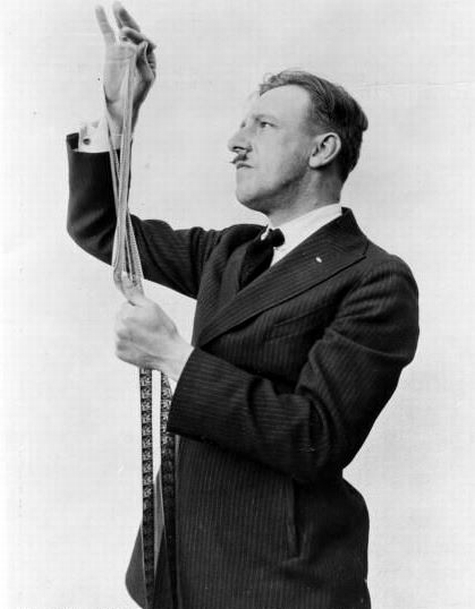
Tod Browning (1880-1962) was a director who achieved acclaim for his infamous classic films Freaks (1932) and Dracula (1931). Browning appeared as an actor in over 50 films and directed 64 silent and "talkie" films from 1915 to 1939[1].
It's very important to understand Browning's unique background, as a young man working in traveling circuses, to understand the casting choices and directing style that gave the fantastic stories that he created a heartfelt and horrorifying credibility.
At the age of sixteen, in 1896, Browning ran away from his upper middle-class home in Louisville, Kentucky and joined a travelling circus. Browning worked for years as a clown, acrobat, contortionist and barker for large and small audiences as part of Ringling Brothers and Barnum and Bailey. His early experiences taught him the value of developing respect for his fellow performers and the nature of the audience that he performed for.
In early 20th century New York, Browning found work in vaudeville shows and in the new American film industry. He appeared in silent films beginning in 1907 for Biograph Studios where he met the first movie mogul, D.W. Griffith. The short movies Browning appeared in were made for Nickelodeons - small theaters screening hand cranked reels of very short films with musicial (usually church organ) accompaniment. The projector technology had it's origin in Kinetoscopes. The early Kinetoscope projector was developed by Thomas Edison and played as a flipbook of photographs for one viewer in a small darkened box - operating like an archiac version of a modern Viewmaster. This projector technology, first seen in "penny arcades", was introduced to larger audiences first as road shows and then in a few playhouses and theaters starting in New Haven, Massachusetts and Pittsburg. In these theaters, patrons could watch continuously playing films for a nickel - simultaneously creating the industry of film-making and film critics.
This created an instant demand for entertainment much like television and the Internet today. Storytellers and showmen like Browning and Griffith were there to make that transition from the simple individual penny arcade "peep shows" to more involved narratives for larger audiences in nickelodeons.
After working his way up as an actor in fifty (or more) of these films for New York film studios, Browning followed D.W. Griffith to California to join his new studio, Reliance-Majestic, in 1913. Two years later in 1915, Browning broke a leg and was left with a facial disfigurement in a deadly car crash that killed his passengers - two fellow actors and friends, Elmer Booth and George Spielman[2]. As he convelesced, Browning began writing scripts and his future within the film industry changed. After recovering, he returned to Reliance-Majestic becoming an assistant director for Grittith on Intolerence (1916), a follow-up to the incendiary blockbuster, Birth of A Nation (1915).
After proving himself capable in the management side of film on Intolerence Tod Browning began working as a director in 1917. His early works were fluffy comedies and then collaborations with the legendary Lon Chaney on silent horror films. He directed the first version of The Unholy Three (1925) and then The Unknown (1927). Both films used vivid elements from Tod Browning's past: travel, danger, double-dealing, carnival girls, knife-throwers, and duplicious midgets.
Browning also began a vampire cycle with Lon Chaney in London After MIdnight (1927). The cycle culiminated with his second "talkie", Dracula (1931). Although Lon Chaney was slated to star, the Man of A Thousand Faces passed away from cancer before production could begin, making Bela Lugosi an instant legend in the process.
Dracula horrified audiences who were used to silent slapstick characters, like The Keystone Cops, and no more than sight gags or "tricks" derived from early effects artists like George Melies. The lack of cinematic predecessors to the evil Count contributed to Dracula's success as a film. The Phantom of the Opera or The Hunchback of Notre Dame - both monsterous creations of Lon Chaney - were both silent films. These films were sometime accompanimenied by live music played by an organ score but featured none of the actor's voices.
Beginning in the darkened theatres of the early 1930's, audiences heard the voice of Lugosi's Count Dracula speaking. Audiences must have shivered as his refined Slavic accent eerily describing the strange howling in the desolate Transylvanian mountainside. The grinning spectre described unseen wolves to an unwitting Johnathon Harker as, "...the children of the night...what beautiful music they make."
The effect must have been fascinating and enthralling. Very few other movies were in sound in 1931. None of them were in the horror genre. This made Dracula, and the Universal horror cycle to follow, wildly successful.
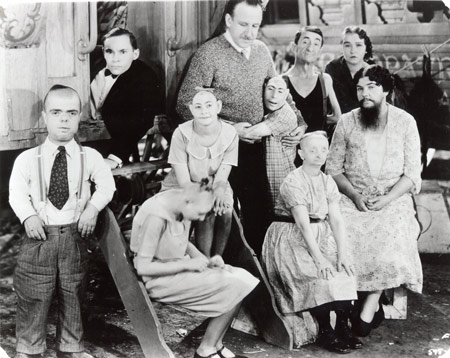
Browning, a former circus performer, is shown here with his actors in a promotional photo in 1931.
Browning's next film, Freaks (1933), has long been a subject of debate as to if MGM was exploiting the actors real life abnormalities. The film was based on a short story called Spurs by Clarence Aaron "Ted" Robbins, a dark story of greed, betrayal and clever retribution among outcasts who bonded into a surrogate family. The movie was made up of real-life circus performers including Johnny Eck, The Hilton Twins, Prince Randian, The Doll Family and long-beloved circus geek, Schlitzie. The script itself was developed in collaboration with actor Harry Earles who also played the regal Tom Thumb-esque, Hans. Earles had previously worked with Browning on the Unholy Three and apparently knew what kind of story to pitch to him.
This film, more than any other horror film, made a deep mark in Hollywood history. It remains legendary for having been banned for decades and derailing Browning's future in film in the process. Although Browning would make a handfull of minor films afterwards, including The Mark of The Vampire (1935) teaming up again with Bela Lugosi.
Browning found himself forced into an early retirement in 1939. Unlike most directors and actors, in particular those working during the Great Depression, Tod Browning retired richly rewarded both commercially and critically successful. He died of lung cancer in 1962.
Notes/Sources Cited:
1 = According to the Encyclopedia of Fantastic Film and Television, Browning's Comprehensive Filmography
2 = Car Crash information detailed at Find A Grave, Tod Browning
References:
Wikipedia, Tod Browning
Wikipedia, American Mutoscope and Biograph Company
Oldschool Reviews, Freaks (1931)
BACK TO ARTICLE
Subscribe to:
Posts (Atom)