"I think of horror films as art, as films of confrontation."

- David Cronenberg

Actors     Actresses     Flicks     Models     Twilight Zone Guide

Directors: Joe Sarno

Anthony Shockly So where did sexploitation come from? Where did it go? To answer that question you must examine the career of proto-porno film director turned hardcore porn film director Joe Sarno.

Joe Sarno, born in 1921 in Brooklyn, had a very successful career in sexploitation a genre that he widely contributed to before becoming a mainstream porn director in the 1980's.

His films examined very real questions about hypocrisy and desire among men and women. Sarno's seemingly bizarre takes on romance concern the place of sex in cultural identity by voicing the questions that were being asked by 1960's American counter-culture to their parents - parents who came from a generation that fought World War Two and whose own parents had survived a ravenous Depression.

This generation gap combined with wide spread political corruption, political upheaval, and an unjust war raging in southeast Asia created a need for a dialogue. What better place than the movie theater?

Sarno, a Navy photographer on South Pacific bombing runs during WWII, became a sexploitation director with his first official feature Sin In The Suburbs (1964). His movies catered to the wilder side of square audiences in the "softcore" market. Sarno's early films confronted sexual frigidity and traditionally accepted hypocrisies about love, women and power by shining a high-powered light into an exaggerated version of mainstream American culture - right were it got it on at.

He did so with unusually well crafted films using stark lighting, long takes, and a purposeful focus on character development. This type of rigorous staging achieved a powerful effect with his actors.

"The big thing with films — a film is the result of a human relationship, and when you write it to begin with, it's got to be about a real human relationship ... that's the whole secret of the thing. Without that, you have nothing."
- From an interview with Joe Sarno in RE/Search #10: Incredibly Strange Films.


After spending many years in a tumultuous American culture as a sexploitation director Sarno moved on to the hardcore porn market simply because popular culture had accepted the place for softcore porn in theaters and collectively yawned.


The Love Merchant directed by Joe Sarno in 1966.

As a contemporary of Roger Corman said: "Tits are the cheapest special effect in the business..." and although tame by today's standards Sarno used sexuality with a brilliance that was often mishandled by many of his peers including Corman and Russ Meyer - and undoubtedly is continually mishandled today.

Selected Filmography:
Sin You Sinners (1964)
My Body Hungers (1964)
Red Roses of Passion (1966)
The Love Merchant (1966)
The Love Rebellion (1967)
The Indelicate Balance (1969)
The Young, Erotic Fanny Hill (1970)
Deep Throat 2 (1974) (Rated R!)
Confessions of a Young American Housewife (1974)
Inside Little Oral Annie (1984)
Coming on America (1989)
Screw the Right Thing (1990)


Before his death, at age 89 in 2010, Joe Sarno's work was the subject of many gallery and film fest retrospectives including the New York Underground Film Festival, the Torino Film Festival in Turin, Italy and the Cinémathèque française in Paris.

References:
IMDB, Joe Sarno
RE/Search #10: Incredibly Strange Films
Mondo Digital, Films of Joe Sarno
Jah Sonic, Joe Sarno
RE/Search #10:Incredibly Strange Films Edited by V. Vale, Andrea Juno, Jim Morton RE/Search Publications San Francisco October 1986
Facebook, Red Roses Of Passion

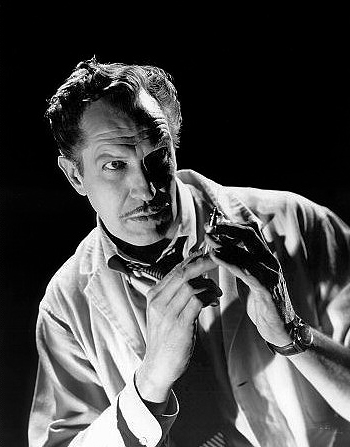
Actors: Vincent Price

Hollywood horror actor Vincent Price
Vincent Price was born in 1911 in St. Louis to an affluent family with a history of spectacular success if only gained through abysmal failure. Vincent would apply the harsh lessons learned by his family his entire life in an industry that was known for instability, greed and long droughts.

The Price family business, The National Candy Company, was founded by Vincent's father and namesake Vincent Leonard Price in 1902. His grandfather, Dr. Vincent Clarence Price, invented a popular baking soda in Illinois that made him a millionaire in the 1880's. Dr. Price would lose this fortune in the Panic of 1893. The family's re-established fortune, earned by his father, would provide a young and determined Vincent with an education at Yale.

During his first month in school in Connecticut Wall Street crashed. Fortunes that took lifetimes to accumulate were lost in a few weeks. On October 29th 1929 men, including some of Price's classmates, killed themselves because they could not bear the thought of being anything other than filthy rich. In his first autobiography I Like What I Know, written in 1958, he remembers:

"I've always believed that the Great Depression was the best thing to happen to all of us children of affluent parents. People were hurling themselves out of windows at an alarming rate and oddly enough some of the jumpers included some of the boys about to enter the big three of Ivy League colleges. I guess the idea of being poor was more than they could face. It seemed to me...ridiculous."

After graduation, Price pursued a career in England as a stage actor while America was in the grip of a severe economic depression in the early 1930's. When he returned to the US he found acting work in New York and enjoyed critical success in traveling shows like Victoria Regina in 1935 and played opposite Orson Wells in Mercury Theater's Heartbreak House in 1938. He managed to keep the bills paid by recording several radio ads and episodes of The Saint.

Hollywood producers, attracted to the money making potential of Price's ability and versatility, attempted to turn the handsome stage actor into a matinee idol without success. Vincent leapt at the chance to build a fortune of his own and signed a contract with MGM in 1937. Price's understanding was that he would play the ill fated Emperor Maximillian of Mexico in a movie entitled Juarez.

As it happened, Vincent Price's first film role was in Service De Luxe (1938) and the film was a real stinker. The film was shot in the traditional heavy-handed screwball comedy style of the era. The script was written by the writing duo of Gertrude Purcell and Leonard Spigelgass who would never write a screenplay for a successful movie during their entire careers. Not even Vincent, or his co-star the sullen but sexy Constance Bennett, could salvage any glimmer or spark in the two-dimensional characters they traded lines with in the picture.

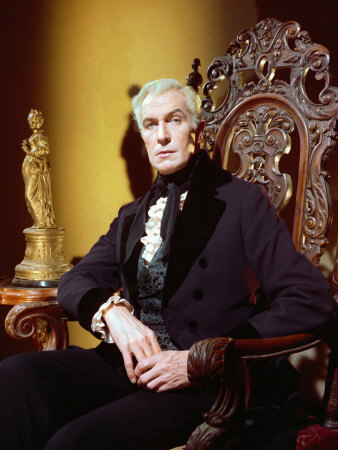
Vincent Price in Fall Of The House Of UsherPrice instead excelled at dark, brooding character portrayals and demonstrated a knack in campy roles. His long association with horror films began with The Invisible Man Returns (1940). However, many of his films throughout the 1940s were costumed period piece epics, such as The Song of Bernadette (1943), A Royal Scandal (1945) with Tallulah Bankhead, and The Three Musketeers (1948) with Lana Turner. All of these films were a return to the heavy-handed tradition of early Hollywood that wanted to churn out bigger-than-the-Bible styled epic films.

Price was often cast in supporting roles in these "A" films, such as Laura (1944) with the luscious Gene Tierney, but his starring roles, for which Price would set himself far above the rest, usually came in the form of "B" pictures. His 1953 film House of Wax would eventually set the stage for a series of horror film roles in the late 1950's through the late 1970's.

In the 1960's, Price had a number of low budget successes with Roger Corman and American International Pictures (AIP) including the Edgar Allan Poe adaptations House of Usher (1960), The Pit and the Pendulum (1961), Tales of Terror (1962), The Comedy of Terrors (1963), The Raven (1963), The Masque of the Red Death (1964), and The Tomb of Ligeia (1965). He also starred in The Last Man on Earth (1964) a film based on the Richard Matheson classic proto-zombie novel I Am Legend.

Vincent was a life long patron of the arts who has inspired countless artists, writers and directors to pursue their own improbable and unpopular dreams. He donated hundreds of his own personal collections of paintings to establish many SoCal galleries.

Vincent Price's health began to badly deteriorate during the production of Tim Burton's Edward Scissorhands (1990). The film was his final major film role before dying of lung cancer in L.A. in 1993 leaving behind three wives, son Vincent Barrett Price and daughter Mary Victoria Price.

Selected Filmography:
The Invisible Man Returns (1940)
The Fly (1958)
The House on Haunted Hill (1958)
The Tingler (1959)
The Return of The Fly (1959)
The Pit And The Pendulum (1961)
The Last Man on Earth (1964)
Dr. Goldfoot and the Bikini Machine (1965)
Dr. Goldfoot and the Girl Bombs (1966)
The Abominable Dr. Phibes (1971)
Dead Heat (1988)
Edward Scissorhands (1990)


References:
Amazon, Vincent Price: A Daughter's Biography Victoria Price, New York: St. Martin's Griffin 2000
I Like What I Know Vincent Price, New York: Doubleday 1958
Wikipedia, Vincent Price
Brian's Drive-In, Vincent Price
Vincent Price P.A., Elizabethtown, KY. Sept. 25, 1980


The Sleaze-A-Saurus Sez:Videos Online At:

Flicks: Q The Winged Serpent (1982)


Who's that ancient deity whose a sex machine with all the chicks? Q! That's who...

Today, in New York City, a flying green snakoid rules w/a tyrannical iron claw. Fiction, sez you? Well, allow me to present Creatures Exhibit #1: Larry Cohen's Q: The Winged Serpent that is. Oh, unwary manlings, the Sleaze-A-Saurus loves him some Larry Cohen. It began with the It's Alive franchise that featured killer mutant babies then the awful consumerism of The Stuff (1984), lasting to present today with his unexpectedly edgy script for Phone Booth (2002).

In 1982's Q, David Carradine (Kill Bill), Richard Roundtree (Shaft, square!) and Micheal Moriarty (Troll) go flyin' snake hunting in downtown NYC. On their way to dispatch the angry, ancient Aztec god of thunder, zany hi-jinks and also, automatic gunfire ensues.


The 80's produced three worthwhile things: big hair, B. A. Baracus and bad movie posters.

The animation for the monster was done with a remarkable similarity in style to Ray Harryhausen (Clash Of The Titans) but the film remains universally disliked by many. Dave Allen (Rick Baker's assistant on The Howling in '82) was on the Animation Production Team that animated Q. Allen went on to several high-profile assignments including: Twilight Zone: The Movie (1983), acting as chief puppeteer for Spielberg's *batteries not included (1987), at George Lucas' ILM for Ghostbusters II (1989), and Allen worked on Puppet Master II and V as the visual effects supervisor for his own company, David Allen Productions.

Randall William Cook, also on the Animation Production Team for Q, went on to work on all three Lord of The Rings films as an Animation Designer and Supervisor at Weta Digital in New Zealand for Peter Jackson.


References:
IMDB, Q (1982)
IMDB, Ghostbusters II (1989)
Motion/Capture, The Last Time I Saw Quezacotl


The Sleaze-A-Saurus Rates It:This Flick Is Available At:

Flicks: The Manster (1962)


A tale of two cultures featuring a two-headed beastie w/a serious thang for the ladies.

Welcome to beautiful rural Japan! Home to lovely dark-eyed ladies, lush forests, evocative nightlife and - blood thirsty two-headed beasties?! So it goes in this United Artists "co-production" between Japanese and US production studios in a film that was originally released in Japan in 1959 and the US in 1962.

In the Manster, professional foreign news correspondent and part-time sucker Mr. Larry Stanford (Peter Dyneley voice of The Thunderbirds) finds himself an unwitting test subject for the nefarious, volcano dwelling Japanese scientist Dr. Suzuki's experiments in "eviloution". Unbeknownst to the the rube, Suzuki uses a mysterious serum to mutate Stanford into a murderous two-headed monster who sets about wrasslin' country girls, caustic secretaries and Buddhist monks.

In a scene from this film that was later re-enacted by Sam Raimi in Evil Dead III 40 years later ol' Stanford sprouts an eye from his shoulder that becomes a full on monkey head! A must see groan fest for innumerable reasons...


References:
IMDB, The Manster (1962)
Wikipedia, The Manster
Girls, Guns and Ghouls, Beware Of Manster


The Sleaze-A-Saurus Rates It:This Flick Is Available At:

Actresses: Kelly Hu

Actresses: Kelly Hu
Sexy Chinese Actress Kelly Hu has been in 77 films and counting.

In a category set at a high bar, actress Kelly Hu is seriously close to perfection. An actress and a model w/V.O. credits and roles on many hit TV shows Kelly Hu began working in TV as far back as Growing Pains and Night Court in the 1980's.

Hu, like many Chinese actresses in American movies, appear almost perfect and poised with classically chiseled porcelain features, such as the flawless Ziyi Zhang. She reflects the best of the Middle Kingdom's culture such as devotion, intelligence and presence-of-mind but is highly feminine and sensitive in a way many American women are not.

The Sleaze-A-Saurus strongly insists that is the fault of Western culture to de-valuate grace and beauty in favor of brutishness and boorishness. Actresses like Kelly Hu will always serve as an interesting comparison to Lady Doo Doo (Gaga) and Britney Spears as the peaks of two rival cultures!

References:
IMDB, Kelly Hu
Asian-Americans.com, Actresses

Flicks: They Call Her One-Eye (1974)


Rape-Revenge genre features both sides of the curious manling's fantasy life. Not terribly complicated creatures are you?

They Call Her One-Eye, the US cut of Thriller – A Cruel Picture, was originally a Swedish rape-revenge film starring Christina Lindberg as Frigga. Lindberg's acting resume is deceptively short but includes co-starring with Japanese beauty Reiko Ike in the amazing The Sex and The Fury (1973).

In They Call Her One Eye, Lindberg's character, Frigga, is introduced as a young girl who was rendered mute during a childhood sexual assault. After spending years on her family's secluded farm she finds herself, as a teenager in the city, Frigga is friggin' raped again.

Christina Lindberg sez adios to an old pal - with lead.
Frigga (Christina Lindberg) sez adios to an old pal - with lead.

This time, she's attacked Tony a shabby lookin' pimp (portrayed by Heinz Hopf) who decides it would be the bee's knees if he digs out her left eye with a rusty X-acto knife. Which he does in a great 1st person POV shot that can only be the result of 60's and 70's experimental film-making.

A One-Eyed Lindberg soon finds herself kidnapped by Tony the Pimp, addicted to junk and forced into sexual slavery as a prostitute. At this point, any other gal woulda gave in - but not Frigga. No friggin' way. After returning to her family's farm Frigga learnes her parents have committed suicide due to evil letters sent by Tony the Pimp and swears a cold-blooded vengeance upon her former captors. Frigga learns martial arts, race car driving and of course - the best in mid-1970's military weaponry.

Christina Lindberg kicks junk - then kicks ass.

Director Bo Arne Vibenius (who appears as a Hot Dog vendor in this flick) also made Breaking Point (1975) (credited as one Ron Silberman Jr.) an even more demented movie than this film. Vibenius's short directorial body of work includes a total of three films which have been called "psycho-pornographic thrillers".


References:
IMDB, Thriller: They Call Her One-Eye
IMDB, Bo Arne Vibenius
Wikipedia, Thriller
You Tube, Theatrical Trailer
Das Grindhaus, Thriller - A Cruel Picture
Mangled Media, Christina Lindberg Galleries


The Sleaze-A-Saurus Rates It:This Flick Is Available At: