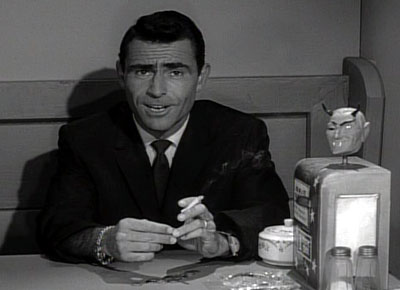
"I think of horror films as art, as films of confrontation."

- David Cronenberg

Actors     Actresses     Flicks     Models     Twilight Zone Guide
Showing posts with label Rod Serling. Show all posts

Creature Features: The Twilight Zone

The Twilight Zone
Twilight Zone Sci-Fi marathon season officially opens at the Blender.

The Twilight Zone Episode Guide is dedicated to the series that formally introduced sci-fi and horror to American house holds over 40 years ago. Rod Serling's brainchild took the fears of his generation: atomic warfare, self-annihilating hatred, bitter jealousy, disfiguring greed and fear of the unknown and made them all into flesh and bone - a half hour at a time.

The Zone lives on here at The Blender where yer ol' buddy, The Sleaze-A-Saurus, has kindly rounded up the episodes that have become as familiar in pop culture as the back of the Sleaze-A-Saurus' tentacle is to unwary, scaleless manlings.

The Twilight Zone: Time Enough At Last (1959)
Burgress Meredith realizes that books is for stalkers.A bookish Burgress Meredith relishes the idea of reading Shakespeare in the ruined ashes of the modern world in the classic 1959 Twilight Zone episode Time Enough. But, can he survive long enough to realize his ambition without the conveniences of the modern day world?
The Twilight Zone: To Serve Man (1962)
Richard Kiel stars in To Serve Man.Newly arrived alien overlord Mr. Richard "Jaws" Kiel of Eegah! and James Bond fame stoically converts the world population of an unsuspecting Earth into intergalactic Space Spam in the 1962 Twilight Zone episode To Serve Man. Can one ace reporter stop it before it's too late?
The Twilight Zone: Two (1961)
Charles Bronson learns to love the bomb in Two.Charles Bronson and Elizabeth "Bewitched" Montgomery, after trying to murder each other with carbines, play like Adam and Eve in the post-Apocalyptic world of 1961 in the classic and very rarely screened, Twilight Zone episode Two.
The Twilight Zone: He's Alive (1963)
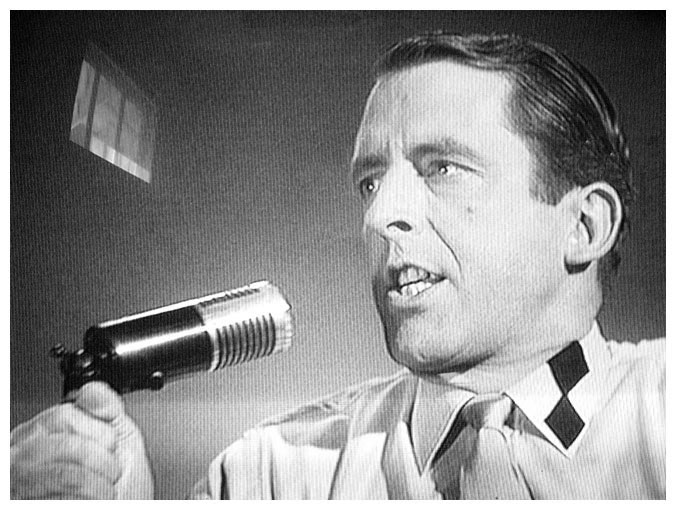
Dennis Hopper delivers one hell of a performance in He's Alive.The late Mr. Dennis Hopper, in a break out TV role that took him from bit roles as a cowboy or extra, delivers one hell of a performance in 1963 in Twilight Zone episode He's Alive. Co-starring none other than the nefarious Fuehrer hisself.

The Twilight Zone: The Obsolete Man (1961)


The Twilight Zone: The Obsolete Man (1961)

The Hall Of Injustice serves up nothing but hilarious death sentences - and that's just for Misdemeanors!

The Obselete Man (from season two episode 65) takes place in a totalitarian state. Burgess Meredith stars as Romney Wordsworth a man put on trial for the crime of being "obsolete." His occupation, to the shock of everyone, is being that of a librarian - a profession that became punishable by death when the State eliminated literacy. To make matters worse, Wordsworth also believes in God which, funny enough, is also punishable by death. The State has declared that there is no God. Wordsworth is prosecuted by the leader and figurehead of this society known only as the Chancellor who declares before an assembled court: Wordsworth, not being an conformist asset to the State, shall be executed.

Upon being convicted of obsolescence, Wordsworth is given a choice as to his method of execution. Drawing a curious reaction from the court, he cryptically requests that he be granted a personal assassin to whom he may disclose his preferred method of death, the Chancellor himself. He also requests that his execution be televised.

In compliance with the condemned man's wishes, a camera is installed in Wordsworth's study to broadcast his death live to the nation, so it's citizens may see Wordsworth in his final hours. He summons the Chancellor, who shows up at 11:15 PM. After some discussion, Wordsworth reveals to the unsuspecting chancellor that he has locked the door, and that his chosen method of death is by an explosive hidden in the room and set to go off at midnight.

Wordsworth intends to show the nation how a spiritual man faces death and proceeds to read Psalm 23 and the beginning of Psalm 53, among others, from his illegal Bible. He also points out that, as the events are being broadcast live, the State will risk losing face by trying to rescue the high-ranking Chancellor. As the time winds down, Wordsworth's calm acceptance of death stands in sharp contrast with the Chancellor's increasing panic.

The Twilight Zone: The Obsolete Man (1961)
In a facist future, atheism is the state religion. John Fritz co-stars as it's high priest, The Chancellor.


Moments before the bomb explodes, the Chancellor, in a desperate plea, finally begs the old man to let him go: "In the name of God, let me out!" Wordsworth immediately obliges, but not without repeating the mention of God — which the State had "proven" not to exist. The Chancellor bursts out of the room to safety just as the bomb explodes and kills Wordsworth, who dies with dignity.

In the final scene, the Chancellor, now stripped of his rank and reduced to a criminal, is declared obsolete. The crowd in the courtroom eventually surrounds him, and proceeds to drag him, kicking and screaming, to his own death sentence.


References:
Wikipedia, The Twilight Zone: The Obsolete Man (1961)
IMDB, The Obsolete Man
The Twilight Zone, Wiki

The Twilight Zone: To Serve Man (1962)

The Twilight Zone: To Serve Man (1962)
Head Chef Richard Kiel prepares to close the book on the human race in: To Serve Man (1962).


To Serve Man
(from season three episode 89) featured the unmistakable Richard Kiel of Eegah! (1962) and The Spy Who Loved Me (1977). To Serve Man is one of the most sardonic and twisted episodes ever launched from the brain of Rod Serling. From a short story of the same name, originally a pulp story appearing in Galaxy Science Fiction in 1950, by Damon Knight.

A strange race of alien giants, known as the Kanamits, land on Earth promising to be humble servants to the cause of humanity. The aliens' intention, announced at the United Nations in New York is to serve Man by sharing their advanced technology. The aliens quickly solve all of Earth's greatest woes, eradicating hunger, disease, and warfare. Soon, humans by the hundred are volunteering for trips to the Kanamite home planet, which they believe is a paradise.

The Twilight Zone: To Serve Man (1962)
"Disking-and-dashing" is punished by Kanamite deep space marination.

Not all is well, however, when a crackerjack ace code-breaker steals a copy of the Kanamite book and discovers the aliens' true intentions: to turn Man into interstellar Spam. Their book, "To Serve Man," is actually a cookbook. The aliens miraculous gifts were designed to make humanity complacent like fattened cows before slaughter.

In the end, Michael Chambers (who's been narrating this story in flashback) is aboard a Kanamite ship, heading for their planet (and almost certain consumption as Man Spam). He looks directly at the audience and says, "How about you? You still on Earth, or on the ship with me? Really doesn't make very much difference, because sooner or later, we'll all of us be on the menu...all of us."

In 2001, the original story by Knight was awarded a Retro Hugo Award as the "Best Short Story of 1951". To Serve Man was also the basis for V: The Series (1984) - a 1980's tv series about hungry reptilian aliens who planned to do very much the same thing to Marc "The Beastmaster" Singer and Faye Grant.


References:
Wikipedia, The Twilight Zone: To Serve Man (1962)
Wikipedia, Richard Kiel
IMDB, The Obsolete Man
The Twilight Zone, Wiki

The Twilight Zone: Will The Real Martian Please Stand Up? (1961)


The Twilight Zone: Will The Real Martian Please Stand Up? (1961)

Small town dilemmas with an extraterrestrial twist are on the menu in this episode of the original Twilight Zone.

Paranoia with a wicked sense of bizarre humor is on the menu in Will The Real Martian Please Stand Up? (from season two episode 64) written by Rod Serling and starring the perrenially odd and humorous Jack Elam.

During a freak snowstorm, two state troopers investigating a crash and are led to believe that it was caused by a UFO. The troopers follow footprints leading from the crash site to a local diner, where a group of passengers from a bus to Boston are waiting for word that a bridge up ahead is safe to cross. There is one more person among the travellers than there were people on the bus. There's a growing suspicion among the stranded travelers as the passengers each try to guess which among them is the alien. When they finally get permission to go across the icy unstable bridge they all leave before the alien is discovered.

Shortly afterwards, Mr. Ross, a businessman played by John Hoyt, returns to the empty diner to tell the cook that the bridge collapsed killing the occupants of both the bus and the police car. As the cook wonders how the businessman survived aloud, Mr. Ross unveils his third arm by stirring his coffee with his third hand. Ross tells the cook that he's a Martian with plans to colonize on Earth.

Laughing, the cook tells Mr. Ross that he's too late. Taking off his paper hat, the cook reveals a third eye. The extra eye is "a trait all Venusians share," he tells his new Martian friend, and that his people, the Venusians, have already started a colony in America - meaning that the "Mr. Ross's" Martian invasion force has been intercepted.

Notes:
The late, great Jack Elam got his start in the infamous anti-marajuana exploitation flick She Shoulda Said No! (1949), later appearing in B westerns and posthumously in DJ Shadow's Entroducing album.


References:
Wikipedia, The Twilight Zone: Will The Real Martian Please Stand Up?
IMDB, Will The Real Martian Please Stand Up?
The Twilight Zone, Wiki
Pop Culture Project, "Will The Real Martian Please Stand Up?"


Season Two of The Original Twilight Zone is available at:
Season Two of The Original Twilight Zone on Amazon

The Twilight Zone: Steel (1963)


The Twilight Zone: Steel (1963)


Episode 122 from season five, is another great Richard Matheson (I Am Legend) script. It stars the broiling Lee Marvin as a desperate man fighting his own greed and a robotic punishment machine. In 1974, boxing has been made illegal. Only robots are allowed in the ring. Former boxer "Steel" Kelly and his manager Pole are forced to make an inhuman decision when their out-dated robotic fighter suffers a final mechanical break down prior to a fight.

The Twilight Zone: Steel (1963)

In the future, the boxer's eyes actually start out blackened.


Steel Kelly is forced into the ring, disguised as his broken robot, where he barely lasts three minutes of the fixed fight against a brutal machine. The rigged fight ends with Kelly taking a fall - bruised and nearly killed but stubborn as ever, Steel tells Pole that with the take money they'll get the parts to fix Maxo.

Matheson's story echoes the unwinnable man vs. machine conflict of the Post-Industrial Revolution world where the souless machine always wins.

In a bizarre recent development, Variey magazine has reported that Dreamworks Studios are spending $80 million on what they are calling Real Steel, an adaptation in which former upbeat tap dancer and Broadway singer Hugh "Wolverine" Jackman will headline. The filming for this atrocity is set to begin in June of 2010. It will arrive in theaters the same day I collapse in epileptic fits of frantic laughter.


References:
Wikipedia, The Twilight Zone: Steel
Wikipedia, Lee Marvin
IMDB, Lee Marvin
Twilight Wiki, Steel
Obsessed With Film, Dreamworks Set To Butcher "Zone" Classic!


Season Five of The Original Twilight Zone is available at:
Season Five of The Original Twilight Zone on Amazon

The Twilight Zone: He's Alive (1963)

The Twilight Zone: He's Alive (1963)
The late great Dennis Hopper (Easy Rider, Blue Velvet) stars in He's Alive.

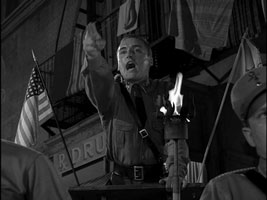
He's Alive, broadcast in 1963 (from season four episode 106), featured the improbable rise of a emotionally shattered young man as he makes an unlikely ascent into the role of an American Hitler. The role starred a then unknown actor Dennis Hopper.

The Twilight Zone's casting directors (under the keen eye of Rod Serling) were on the look out for new talent in the early sixties. The Zone gave many struggling actors, like William Shatner and Lee Marvin, starring roles on national television. One of these roles went to a young, angry Dennis Hopper.

Hopper was previously cast in two roles with James Dean (whom he admired immensely) in Rebel Without a Cause (1955) and in Giant (1956). Dean's death in a 1955 car accident affected the Hopper deeply. In LA, Hopper's roommate actor Nick Adams, who was known for roles in Japanese films, also died young before he could achieve lasting fame. All of this emotional rawness and professional trugdery in tv westerns happened years prior to his acting and directing break through on Easy Rider (1969). In the late 1950's and 1960's Hopper's career was strictly bit roles in crumby cowboy flicks and B-movies.

The Twilight Zone: He's Alive (1963)
In He's Alive, broadcast in 1963, Hopper plays Peter Vollmer a young man who taken in from the city streets by an old Jewish man. Ludwig Donath plays an elderly Holocaust survivor only to have Vollmer turn neo-Nazi on him when Vollmer trades his soul for the cunning advice of a mysterious, shadowy man with a German accent.

After a series of successful rallies, the stranger in the shadows reveals himself to be, in fact, Adolf Hitler (veteran tv actor Curt Conway). On Hitler's orders, Vollmer kills his benefactor the old man. When the police arrive to arrest Vollmer for conspiracy for a previous crime he's shot while fleeing the scene. Hitler leaves, off to search for another worthy candidate.

In closing, Rod Serling eulogizes democracy as Hitler scuttles away in the shadows:

"Where will he go next, this phantom from another time, this resurrected ghost of a previous nightmare - Chicago; Los Angeles; Miami, Florida; Vincennes, Indiana; Syracuse, New York? Anyplace, everyplace, where there's hate, where there's prejudice, where there's bigotry. He's alive. He's alive so long as these evils exist. Remember that when he comes to your town..."

According to the Internet Movie Database, He's Alive drew more hate mail than any other episode. This reaction was a solid review of Hopper's performance and the country's reaction to violent totalitarianism if only in a fictionalized metaphor.


References:
Wikipedia, The Twilight Zone
Wikipedia, Dennis Hopper
IMDB, Dennis Hopper

The Twilight Zone: Nightmare At 20,000 Feet (1963)

The Twilight Zone episode Nightmare At 20,000 Feet
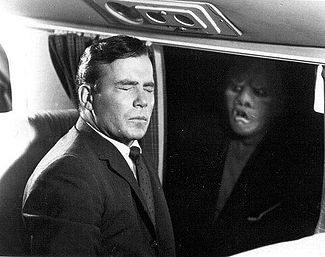
William Shatner comes to face to face with his fear of flying in Nightmare At 20,000 Feet.

The 1983 movie version of the Twilight Zone contained a segment based the 1963 tv episode "Nightmare At 20,000 Feet". This original episode starred, you guessed it, William Shatner. Only three years away from his break through role on Roddenberry's Star Trek in 1966, Shatner was finding regular work in Hollywood television production like the Twilight Zone. He'd previouslly been featured in the 1960 episode "Nick of Time" as well as several local western productions such as NBC's The Outlaws Western.

Nightmare At 20,000 Feet (season five episode 123?) was another Richard Matheson entry into the tv series. William Shatner plays Bob Wilson, a salesman, who finds himself on an airplane for the first time since his recent nervous breakdown.

Enter Rod Serling, slinking onboard to set the stage:

“Portrait of a frightened man: Mr. Robert Wilson, thirty-seven, husband, father, and salesman on sick leave. Mr. Wilson has just been discharged from a sanitarium where he spent the last six months recovering from a nervous breakdown, the onset of which took place on an evening not dissimilar to this one, on an airliner very much like the one in which Mr. Wilson is about to be flown home - the difference being that, on that evening half a year ago, Mr. Wilson's flight was terminated by the onslaught of his mental breakdown. Tonight, he's traveling all the way to his appointed destination, which, contrary to Mr. Wilson's plan, happens to be in the darkest corner of the Twilight Zone."

Wilson spots an evil "gremlin" (actually what looks like an extra in a bad paper mache mask left over from Eye of the Beholder from 1960) hovering on the wing of the plane. Each time someone else looks out the window, the "gremlin" leaps out of view. No one believes Bob when he claims he has spotted a gremlin. Bob realizes that his wife is starting to think he needs to go back to the sanitarium... but if nothing is done about the gremlin, it will damage the plane enough to cause it to crash. Bob snatches a sleeping policeman's revolver then opens the "Auxiliary Exit" to shoot the gremlin, succeeding despite the fact that he is nearly blown out of the plane himself.

Once the plane has landed, Wilson is whisked away in a straitjacket, but there is evidence of his claims: unusual damage to the plane's engine — yet to be discovered by mechanics — that presumably can only be explained as being caused by something clawingat the structure's airframe. The original role of Bob Wilson is further polished by John Lithgow 20 years later minus the paper mache mask and man-girdle.

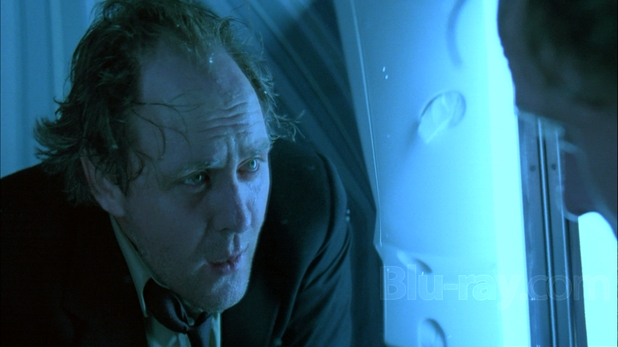
John Lithgow is kinda scared of flying in The Twilight Zone (1983)
In the film update of Nightmare, John Lithgow is also "kinda scared of flying".

As part of the Twilight Zone movie, Lithgow encounters a less hokey lookin' gremlin - who, like his paper mache counterpart from 1963, has a real hard-on for air traffic related mayhem. At the end of this segment, Dan Akroyd delivers a classic line in a bit part as a creepy Paramedic asking an already shook up Lithgow: "You wanna see something really scary?"


References:
Wikipedia, Nightmare At 20,000 Feet
Wikipedia, William Shatner
Cult TV, Twilight Zone Episode Guide
Twilight Zone Autographs


Season Five of The Original Twilight Zone is available at:
Season Five of The Original Twilight Zone on Amazon

The Twilight Zone: The Nick of Time (1960)


The Twilight Zone: The Nick of Time (1960)

Rod Serling sets the scene like a half-amused beatnik with a few minutes to lay it all out for "squares".

Who doesn't enjoy to love or hate William Shatner? He's too big to ignore completely. Shh-h-h-h-h-atner. The word should be a verb for over-acting. The guy wore a man-girdle and tupee for three years as Captain James "Jim" Tiberius Kirk and was still a sex symbol. Come on! No. Seriously. Come on!

Nick of Time (episode from season two of the series), first broadcast in November of 1960, features Kirk wheeling into town with his new MILF/Cougar wife wincingly played by Patricia Breslin, who later married both Darren from Bewitched and the Cleveland Browns former owner Art Modell. That being noted, in The Nick Of Time, The Carters are on there way to big bucks as Kirk has landed a high-powered job in New York City.

The Twilight Zone: The Nick of Time (1960)

Before cell phones or tricorders, 20th century man relied on cheap gimmicks to communicate with his world.


Enter the icy hand of Chance, coming in the form of a innocent looking "fortune-telling machine" that looks suspiciously like a napkin dispenser. The Carter's stop for lunch during their road trip at the Busy Bee Cafe in the fictional town of Ridgedale, Ohio and begin consulting the machine.

Although this episode was written by Richard Matheson (of "I Am Legend" fame) several ridiculous things keep happening in this episode. The fortune machine keeps correctly predicting the future while Kirk's wife gets antsy about his faith the machine - a faith that results in them never leaving good old Ridgedale because a bedeviled napkin dispenser said "no".


References:
Wikipedia, The Nick of Time
Cult TV, Twilight Zone Episode Guide
Twilight Zone Autographs


Season Two of The Original Twilight Zone is available at:
Season Two of The Original Twilight Zone on Amazon

The Twilight Zone: Time Enough At Last (1959)

The Twilight Zone episode Time Enough at Last
World's greatest literature enthusiast runs into a sight - er - slight dilemma during the post-atomic apocalypse.

As the holiday season quickly comes and goes it's time to rememember that other annual tradition - The Twilight Zone marathon. The Sleazeblender is proud to begin a tradition of it's own, new for 2010, each day for the next two weeks The Seaze-A-Saurus will publish a review of the episodes that made the series great.

Ladies and germs, welcome to the Twilight Zone Episode Guide.

Rod Serling, the creator of the series, was a brash genius who used his one-of-a-kind production talents to examine cultural traditions, oppressive fear and military morality into 21-minute-long suspense driven episodes confronting post-war American life. For TV, even by modern standards, this is unheard of. TV, for generations, has existed to obscure reality not to confront it! To confront paranoia and prevailing social anxieties in the "duck and cover" era of Lassie and the Dick Van Dyke Show in the 1950's seems an impossible challenge. Cue Jerry Goldsmith's guitar-and-bongo riff right here. Welcome to the 5th dimension campers - the Twilight Zone.

Time Enough At Last (from the first season of the series, episode 8) was first broadcast in November 1959, as the fear of a imminent devastating nuclear war with Russia seemed inevitable. Time Enough tells "the story of a man who seeks salvation in the rubble of a ruined world".

The episode begins with Serling stepping into frame to deliver his sly, trademarked setting of the scene, doing so unnoticed in the middle of a busy bank:

"Witness Mr. Henry Bemis, a charter member in the fraternity of dreamers. A bookish little man whose passion is the printed page but who is conspired against by a bank president and a wife and a world full of tongue-cluckers and the unrelenting hands of a clock. But in just a moment Mr. Bemis will enter a world without bank presidents or wives or clocks or anything else. He'll have a world all to himself, without anyone."

Enter henpecked bank teller Henry Bemis, played by Burgess Meredith. He loves books, yet is surrounded by those who prevent him from reading them. The episode follows Bemis through the end of the world, touching on social issues as unlikely as anti-intellectualism, atomic warfare, and the difference between solitude and loneliness.

Bemis, gathering books by the hundred, is at last undone by fatefull accident. The civilized world that had prevented him from reading has been swept away and is no longer present to make a simple repair his broken glasses. The episode closes as Bemis bemoans his fate, surrounded by years worth of books he'd intended to read, clutching the remains of his broken glasses and wailing: "That's not fair. That's not fair at all. There was time now. There was all the time I needed...!"


References:
Wikipedia, Time Enough At Last
The Offical: Burgess Meredith.com


Season One of The Original Twilight Zone is available at:
Season One of The Original Twilight Zone on Amazon